One site, many trades, one shared success
On a building site, nobody works alone. The mason, plumber, electrician, drywaller, joiner, tiler, painter or HVAC technician often work in the same rooms, sometimes on the same day. Each one masters their trade, but the final quality depends above all on how their work is sequenced and connected. That is what trade coordination is all about.
In Casablanca, where many projects are delivered in separate work packages, on constrained plots and with tight deadlines, coordination problems are one of the most frequent sources of rework, extra costs and delays. This article explains what interfaces between packages are, why they cause problems and how to control them.
What is an interface between work packages?
An interface is a point of contact between the work of two or more contractors. It can be physical (an electrical conduit running through a partition, a drain passing through a slab, a window frame fitted into a masonry opening), chronological (tiling can only start once embedded services are installed and inspected) or contractual (who supplies, who installs, who connects, who makes good?).
Some very common examples:
- openings and shafts to be provided in the structural works for plumbing, electrical and air-conditioning services;
- items to be cast into slabs and walls before concrete pouring;
- partitions to be closed only after services have been installed and tested;
- external joinery and its weatherproofing with the façade;
- suspended ceilings, which must integrate light fittings, ventilation grilles, detectors and access hatches;
- making good and sealing around penetrations, often forgotten because they are “nobody’s responsibility”.
Why interfaces cause problems
Most coordination problems do not come from a lack of skill, but from grey areas between responsibilities. The causes come up again and again:
- unclear scope boundaries in the contracts, which leave some tasks without a clear owner;
- uncoordinated drawings: each package works from its own drawings, without checking clashes between services, structure and architecture;
- a poorly defined sequence of works, which leads a contractor to start too early or to wait needlessly;
- information that does not flow, for example a change agreed with one package without the others being informed;
- shared work areas without rules, with equipment getting in the way, damaged work and responsibilities that are hard to establish.
The result is well known: chases cut into new plaster, openings drilled into concrete after the fact, suspended ceilings taken down to run a forgotten service, finishes redone several times. Every piece of rework costs time and degrades quality.
The tools of good coordination
1. Clarify scope boundaries
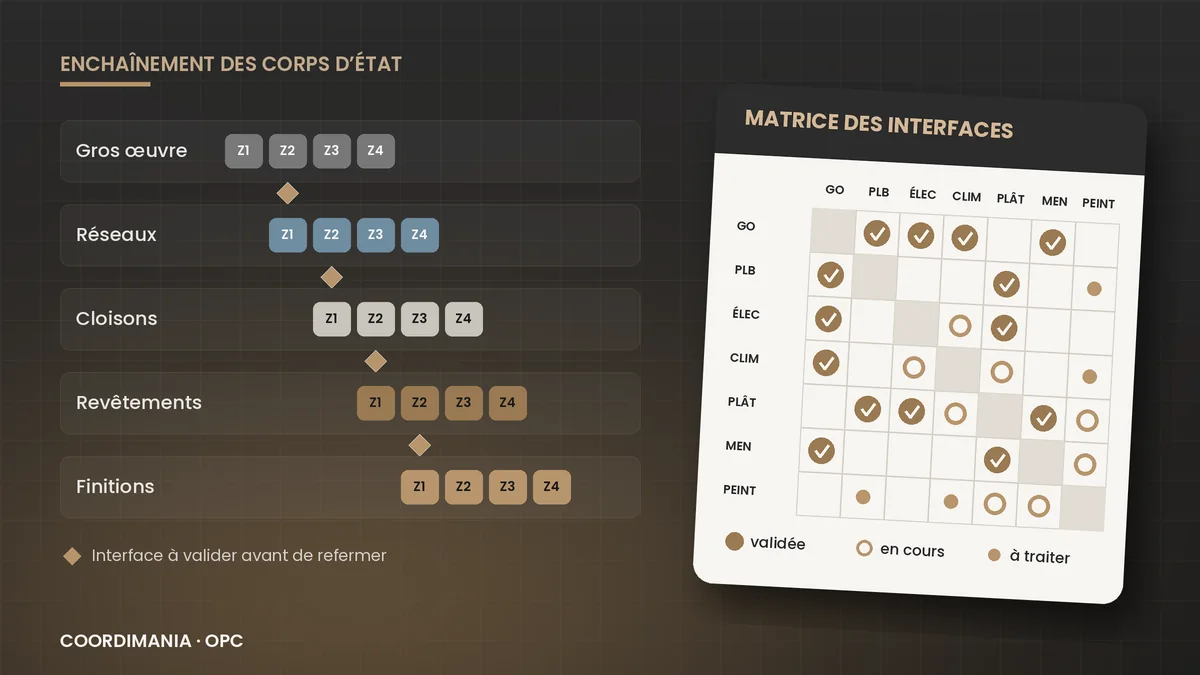
From the preparation period onwards, it is useful to draw up an interface schedule: for each point of contact between packages, it states who supplies, who installs, who connects, who inspects and who makes good the finishes. Shared with all contractors, this document prevents tasks from falling between two contracts.
2. Coordinate drawings before execution
Overlaying structural, architectural and services drawings makes it possible to detect clashes before they appear on site. It is far easier to move a service on a drawing than to drill through a beam or demolish a ceiling.
3. Organise the sequence of trades
The construction schedule must reflect the logical order of works, zone by zone or floor by floor: structural works, embedded services, partitions, exposed services, plastering, floor and wall finishes, equipment, final finishes. Splitting the site into zones allows several packages to work in parallel without getting in each other’s way, each one “following” the previous one from floor to floor.
4. Check before closing up
Before one element hides another package’s work (pouring a slab, closing a partition, installing a suspended ceiling), a joint inspection is essential: services installed, tests carried out, openings compliant. A simple checklist signed by the packages concerned avoids many later disputes.
5. Share information continuously
The weekly site meeting is the natural place to deal with interfaces: blocking issues, clashes between packages, decisions to be made. The minutes then record the actions, owners and deadlines, so that every contractor works with the same information.
Common mistakes to avoid
- assuming each contractor will “sort things out” directly with the others;
- starting works without checking that the drawings of the different packages are compatible;
- letting finishes start while services are neither complete nor inspected;
- accepting changes during construction without measuring their impact on the other packages;
- failing to protect completed work, which then gets damaged by subsequent trades;
- leaving small interface works until the end, where they turn into snags at handover.
The role of OPC in coordinating trades
Coordination is at the heart of the OPC assignment (scheduling, project steering and site coordination). The OPC sequences the works of the different packages, builds and updates the schedule, identifies interfaces, facilitates exchanges between contractors and follows actions through to completion. It makes sure that each package has, at the right time, the information, work areas and preceding works it needs.
The OPC replaces neither the lead design team, responsible for design and technical compliance, nor the contractors, responsible for their own works. It links everyone together so that the site moves forward as a coherent whole. To better understand this division of roles, read OPC or lead designer: what is the difference? and What is an OPC in construction?
In summary
Coordinating trades well means clarifying who does what at each interface, checking drawing compatibility before execution, organising the sequence of packages by zone, inspecting before closing up and sharing information continuously. It is also one of the most effective levers to avoid construction delays in Casablanca and limit costly rework.
Launching a multi-package project in Casablanca? Discover our OPC services, our five-step method or contact us.