The first weeks often determine what follows
On a construction project, the temptation to “start fast” is strong: earthworks as soon as the contract is signed, contractors mobilised immediately, first orders placed in a rush. Yet experience shows that many delays, reworks and tensions between stakeholders stem from a poorly prepared start. The preparation period is precisely meant to lay the foundations of an organised site before the works pick up pace.
In Casablanca, where plots are often constrained, access limited and neighbours very close, this organisation time is even more valuable. This article explains what the preparation period is, what should be dealt with during it and how to make it a real lever for success.
What is the construction preparation period?
The preparation period is the phase that follows the award of contracts and precedes the actual execution of the works. Its duration and content depend on the operation and on what the contract documents provide; they must therefore be checked project by project. During this phase, the contractors, the lead design team, the project owner and the OPC get organised: they exchange documents, approve methods, build the schedule and prepare the site set-up.
This is not lost time: it is time invested. A week spent clarifying the organisation can save several during the works.
Why this phase is often neglected
Several reasons explain why it is shortened or even skipped:
- pressure from the overall deadline, which pushes for works to start as early as possible;
- contracts signed late, which reduce the time available before the announced start date;
- design studies not quite finished, which people hope to complete “along the way”;
- the feeling that organisation will come naturally once the teams are on site.
In reality, whatever is not organised before the start has to be organised during the works, in a rush and often at the cost of stoppages or rework.
The workstreams of the preparation period
1. Analyse the documents and contracts
First step: make sure everyone has the right documents and has understood them. Drawings, written specifications, scope boundaries between packages, contractual deadlines: inconsistencies or omissions spotted at this stage are easily resolved. Spotted in the middle of construction, they become sources of disputes.
2. Build the master schedule
The construction schedule is drawn up or consolidated during the preparation period, based on the contract deadlines and the constraints of each contractor. It shows the sequence of packages, the key milestones and the critical path. Shared and approved by all, it becomes the common reference for tracking progress.
3. Prepare the site set-up
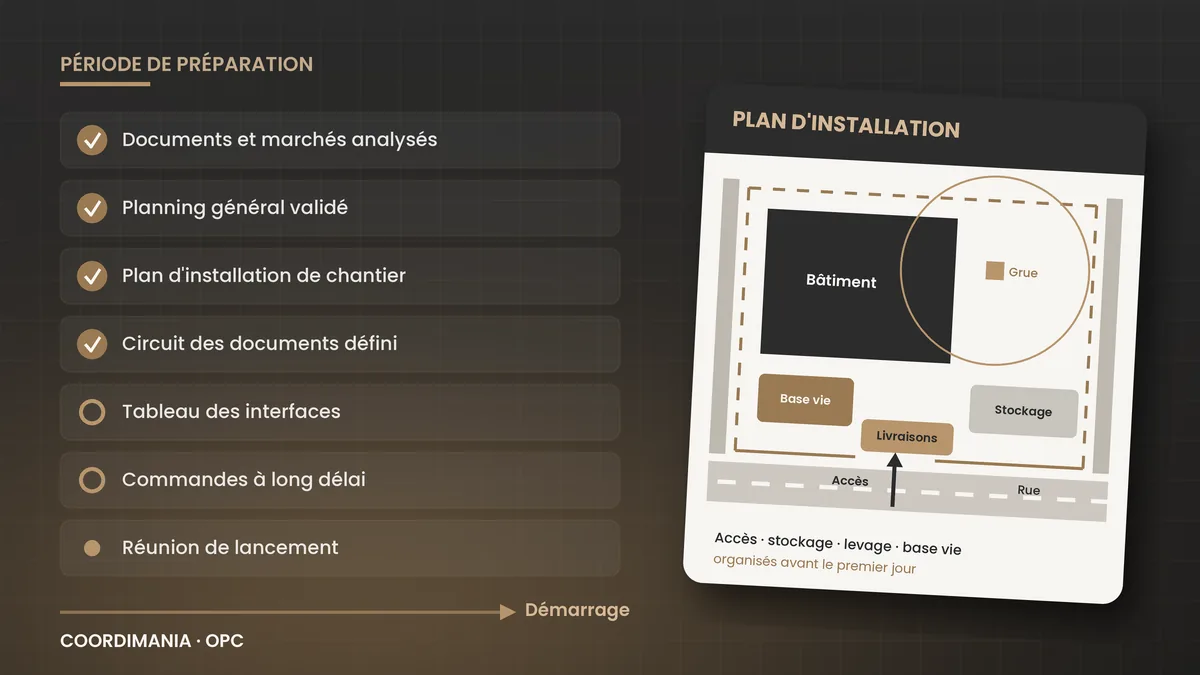
The site layout plan sets out the physical organisation of the site: access and hoarding, site welfare facilities, storage areas, location of lifting equipment, delivery areas, temporary water and power connections, waste management. On a narrow Casablanca plot, surrounded by adjoining buildings and a busy street, every square metre counts and deliveries must be organised to limit disruption.
4. Organise the flow of information
Who approves the construction drawings? Within what time frame? Who receives the minutes? Defining from the outset the contact persons, the document distribution circuit and the rhythm of the site meeting avoids misunderstandings and decisions taken without everyone being informed.
5. Identify interfaces between packages
The preparation period is the right time to list the points of contact between contractors: openings, cast-in items, sequence of works, shared finishes. An interface schedule and a first coordination of drawings help anticipate clashes. To go further, read our guide on coordinating trades.
6. Anticipate procurement
Some materials and equipment require long manufacturing or delivery lead times: joinery, technical equipment, lifts, specific materials. Identifying them during preparation, getting choices approved and placing orders at the right time prevents them from blocking the site several months later.
7. Safety and neighbours
Safety organisation, signage, collective protection, a joint condition survey of neighbouring buildings before the start: these points protect people and limit later disputes, particularly in dense urban areas.
What you should have in hand when works start
At the end of a well-run preparation period, the site generally has:
- an approved and shared master schedule;
- a site layout plan;
- a list of stakeholders and a document distribution circuit;
- an interface schedule between packages;
- a timetable for approvals and long-lead orders;
- the minutes of a first meeting setting out the working rules.
Common mistakes to avoid
- starting works with construction drawings that have not been approved;
- letting each contractor draw up its own schedule without consolidation;
- improvising the site set-up as people arrive;
- forgetting long-lead orders until the moment they are missing;
- neglecting relations with neighbours and site access at the start of the operation.
The role of OPC during preparation
The preparation period is a key moment in the OPC assignment (scheduling, project steering and site coordination). The OPC collects the contractors’ schedules and consolidates them into a master schedule, organises the kick-off meeting, sets up the monitoring tools, identifies interfaces and points requiring quick decisions, and ensures that each stakeholder knows what to do and when. It thus prepares the ground for effective steering throughout the works.
The OPC replaces neither the lead design team, responsible for design and technical compliance, nor the contractors, responsible for their methods and their works. To better understand this division of roles, read OPC or lead designer: what is the difference? and What is an OPC in construction?
In summary
Starting a project well means taking the time to check documents, build a shared schedule, organise the site set-up, clarify the flow of information, identify interfaces and anticipate orders. It is one of the surest ways to avoid construction delays in Casablanca.
Preparing to launch a project in Casablanca? Discover our OPC services, our five-step method or contact us.